Free Guide
The Kettlebell Blueprint
Everything you need to start training with kettlebells, get strong and lose the weight. All you need is a couple of bells and a corner of a room.
 By Wladimir Salas, The Kettlebell Academy
01 · Read this first
You didn't decide to get out of shape
Nobody does. You just kept saying yes to comfort, one convenient decision at a time. You built a career, a business, a family, a life you're proud of. And somewhere in the middle of building all of it, your own body slid to the bottom of the list.
Then one day you catch yourself in the mirror, or out of breath on the stairs, and you don't recognize the person looking back. You used to move. You used to feel strong.
If that sounds familiar, good. This guide is for you.
This isn't a workout PDF you skim once and forget. It's the same system, the same standards and the same approach I use with the people I coach one on one. Read it and you'll know more than most people in the gym. Do it and you'll be stronger in four weeks than you are today.
02 · Why this matters
Your health is a business issue
Here's what most of the fitness industry won't say to your face. Your health isn't a wellness topic. It's what everything else in your life runs on.
When you're responsible for everything, the business, the team, the family, your body is the engine. Low energy, bad sleep, a back that hurts every morning and a brain that's foggy by 3 p.m. cost you money, decisions and patience with the people you love.
Money means nothing without your health. You can't spend it from a hospital bed. Your money can buy the watch. It can't buy the body.
And the person who's willing to do the hard thing in the morning when nobody's watching is usually the same person who outworks everybody else everywhere else. This was never about looking good for a photo. It's about protecting the one asset that lets you keep doing everything you've built, for as long as possible.
03 · Why the kettlebell
One tool. Your whole body.
You don't have two hours to drive to a gym, wait for equipment and cycle through five machines that have nothing to do with how your body moves in real life. You have about thirty minutes and a corner of a room.
That's the whole case for the kettlebell. With a couple of bells at home you can train:
- Strength, so everyday life gets easier
- Muscle, which keeps your metabolism up and your body looking athletic
- Conditioning, so you're not winded on the stairs
- Mobility and balance, so you move well and stay pain free as you get older
- Power, the ability to move fast, which is the first thing we lose with age
No commute. No waiting on machines. Nothing between you and the work. That's why my clients stay consistent, and consistency is what gets results.
Why lift at all?
Cardio burns calories while you're doing it. Strength training changes your body for good. Muscle keeps your metabolism up, protects your joints and keeps your bones strong. After 30 you slowly start losing it every decade unless you fight for it, and that loss is what turns a slip into a fall when you're older.
My grandfather didn't fall because he was sick. He fell because he didn't have the strength or the mobility to catch himself. That's why I take this so seriously. Strength is what keeps you independent for the rest of your life.
04 · Choosing your bells
What weight should you buy?
You don't need a rack of kettlebells. You need two to start: a lighter one for the single arm work (cleans and presses) and a heavier one for the hinges (deadlifts and swings).
| Clean & press bell | Deadlift & swing bell | |
|---|---|---|
| Most men | 16 kg (35 lb) | 20 to 24 kg (44 to 53 lb) |
| Most women | 8 to 12 kg (18 to 26 lb) | 12 to 16 kg (26 to 35 lb) |
The quick test
- Press bell: you can press it overhead for 5 clean reps per arm without arching your back.
- Swing bell: you can swing it for 15 reps without your back rounding or the bell pulling you forward.
When to move up
When you hit the top of the rep range for every round with clean form, two sessions in a row. Never move up because you're bored.
05 · The 5 core movements
Learn these five right
These five movements, done right, build every quality you need. Learn them in this order. Each one builds on the one before it.
Every move has three photos: where the rep starts, where it finishes, and the mistake most people make. Film yourself from the side doing 5 reps, pause the video at the bottom and the top, and compare it to the photos. If something doesn't match, that's what you fix first.
MOVE 1
Kettlebell Deadlift
The foundation. Every other move on this list depends on this pattern, the hip hinge.
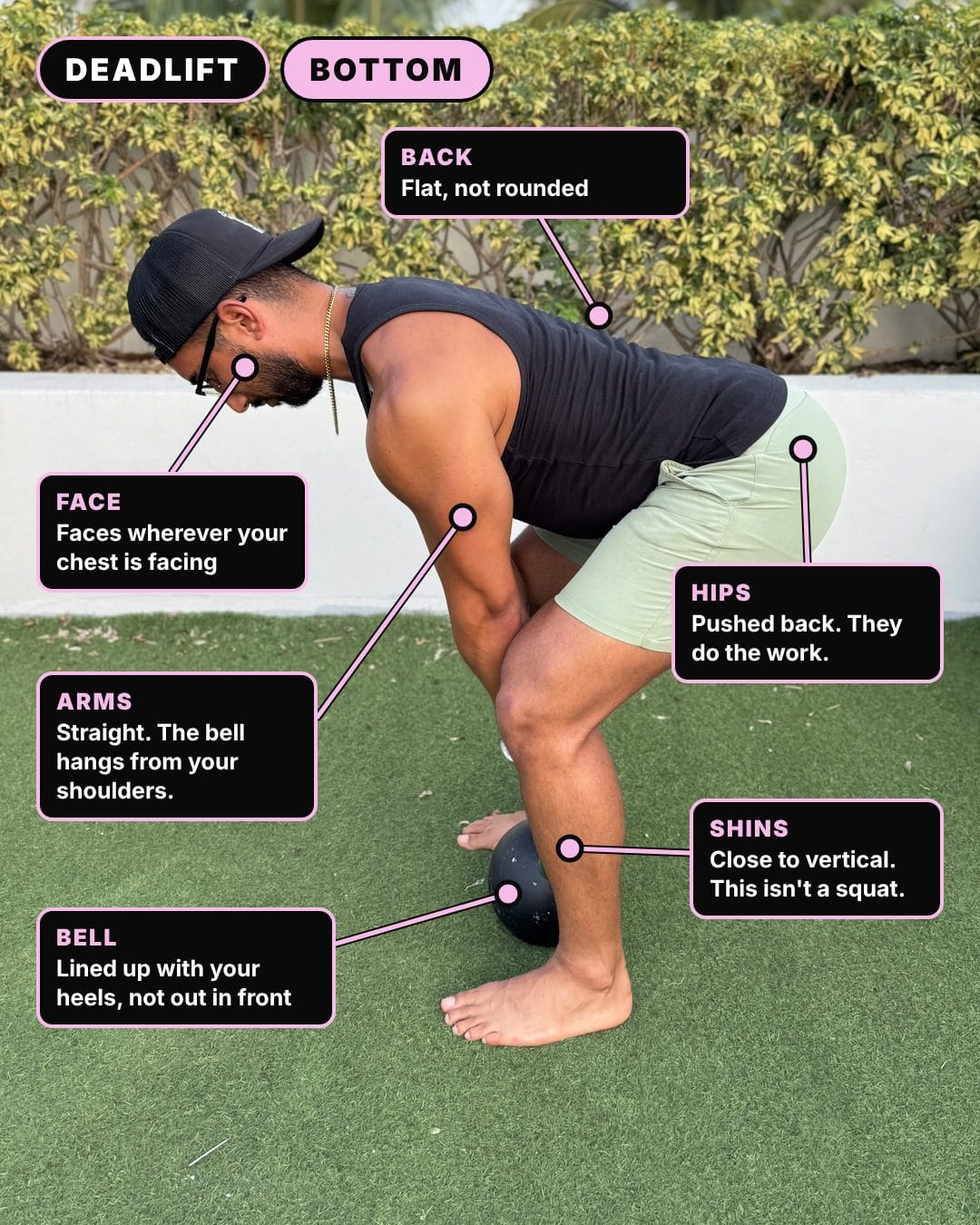
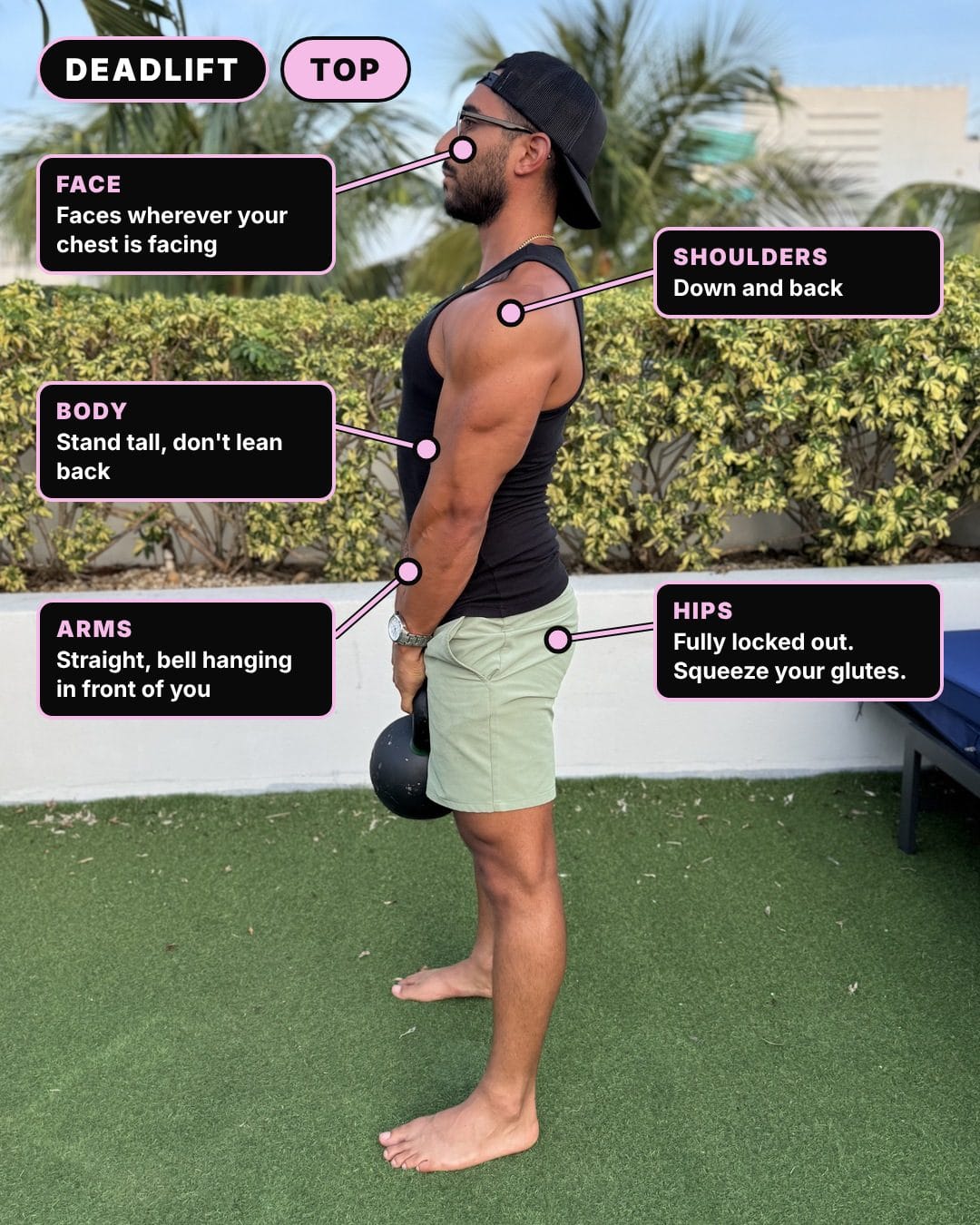
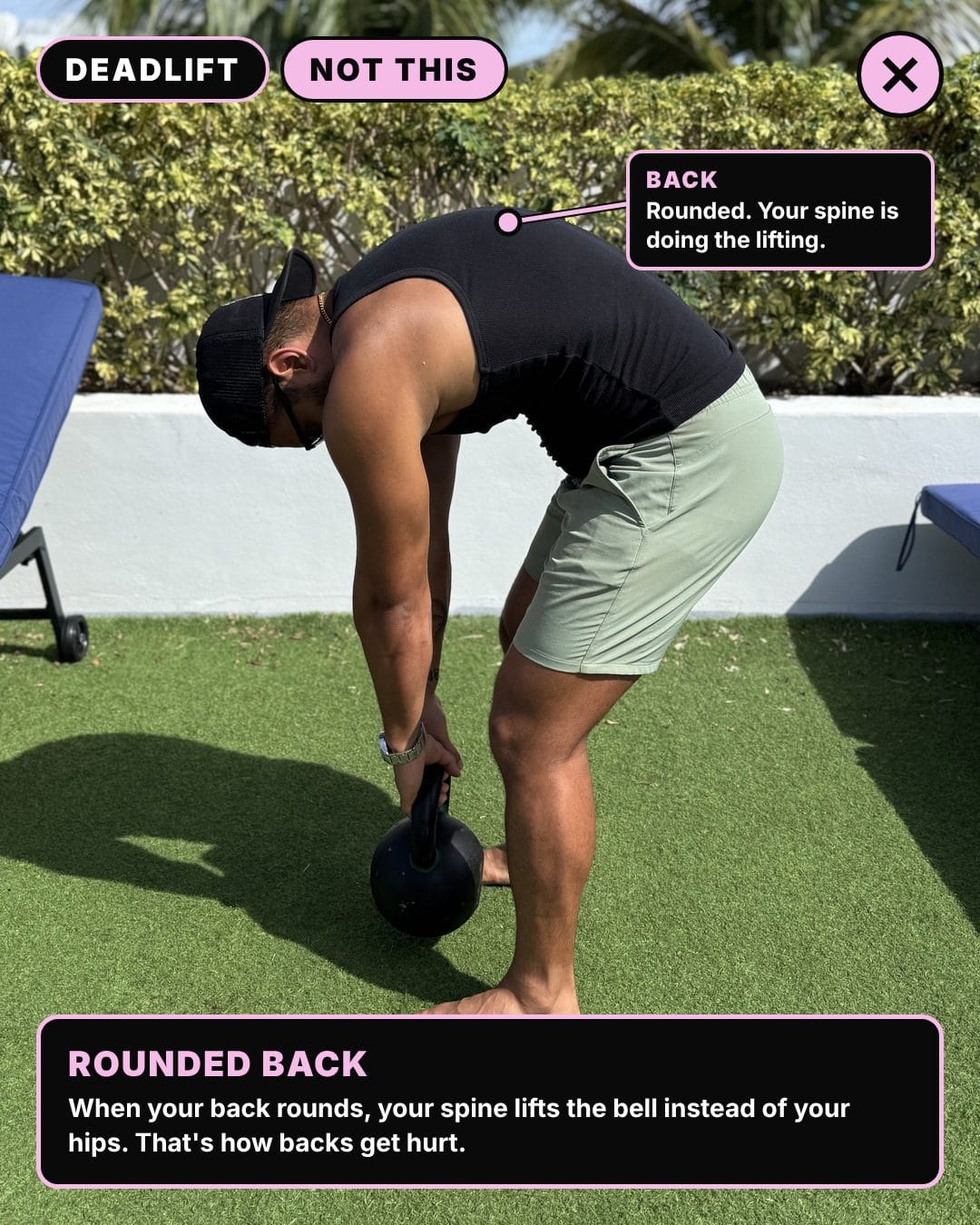
Push your hips back, don't squat down to the bell. Bell lined up with your heels, back flat, arms straight. Stand up by driving your hips forward.
MOVE 2
Kettlebell Swing
The engine. Builds explosive hip power and burns more energy than almost anything you can do in twenty minutes.
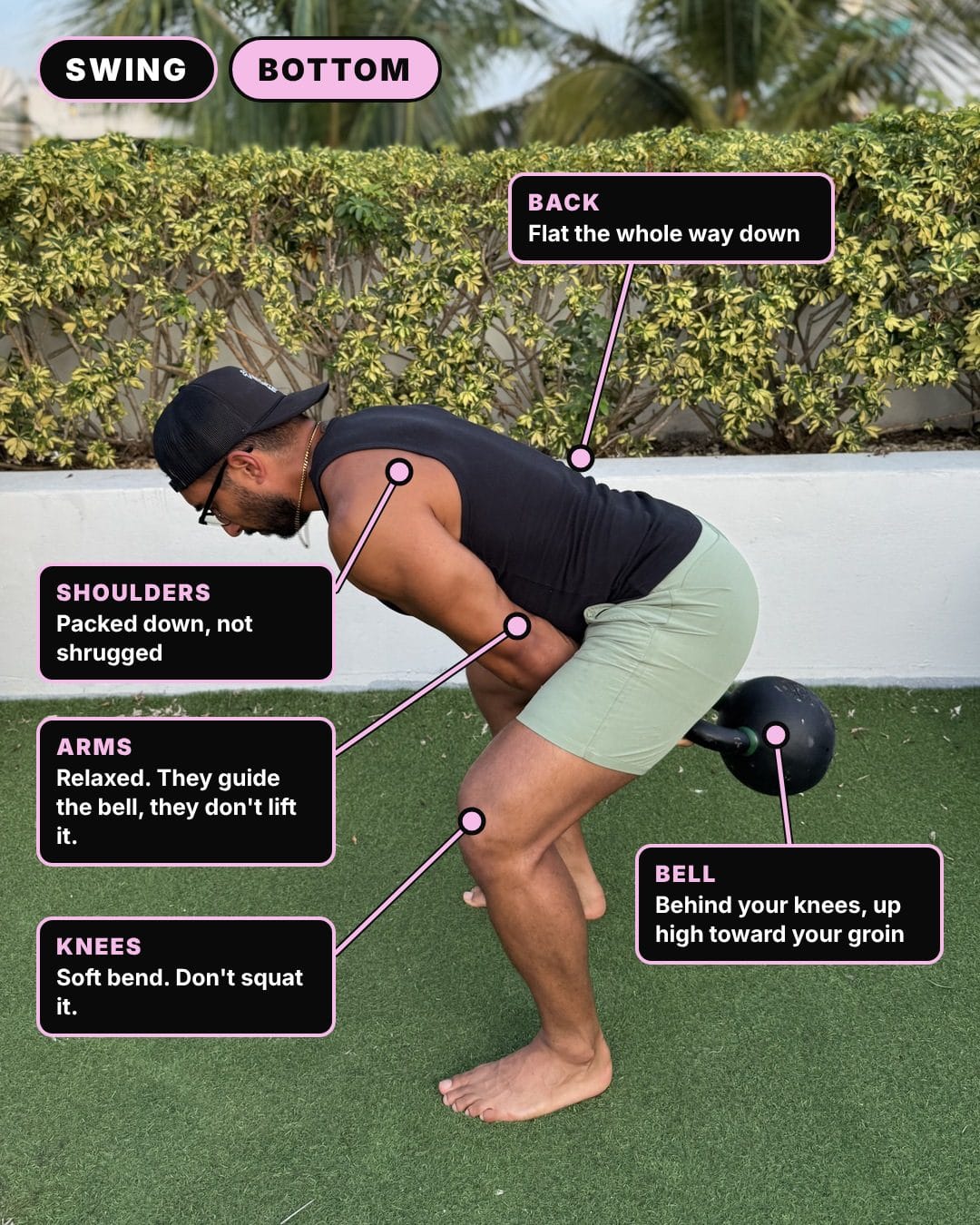
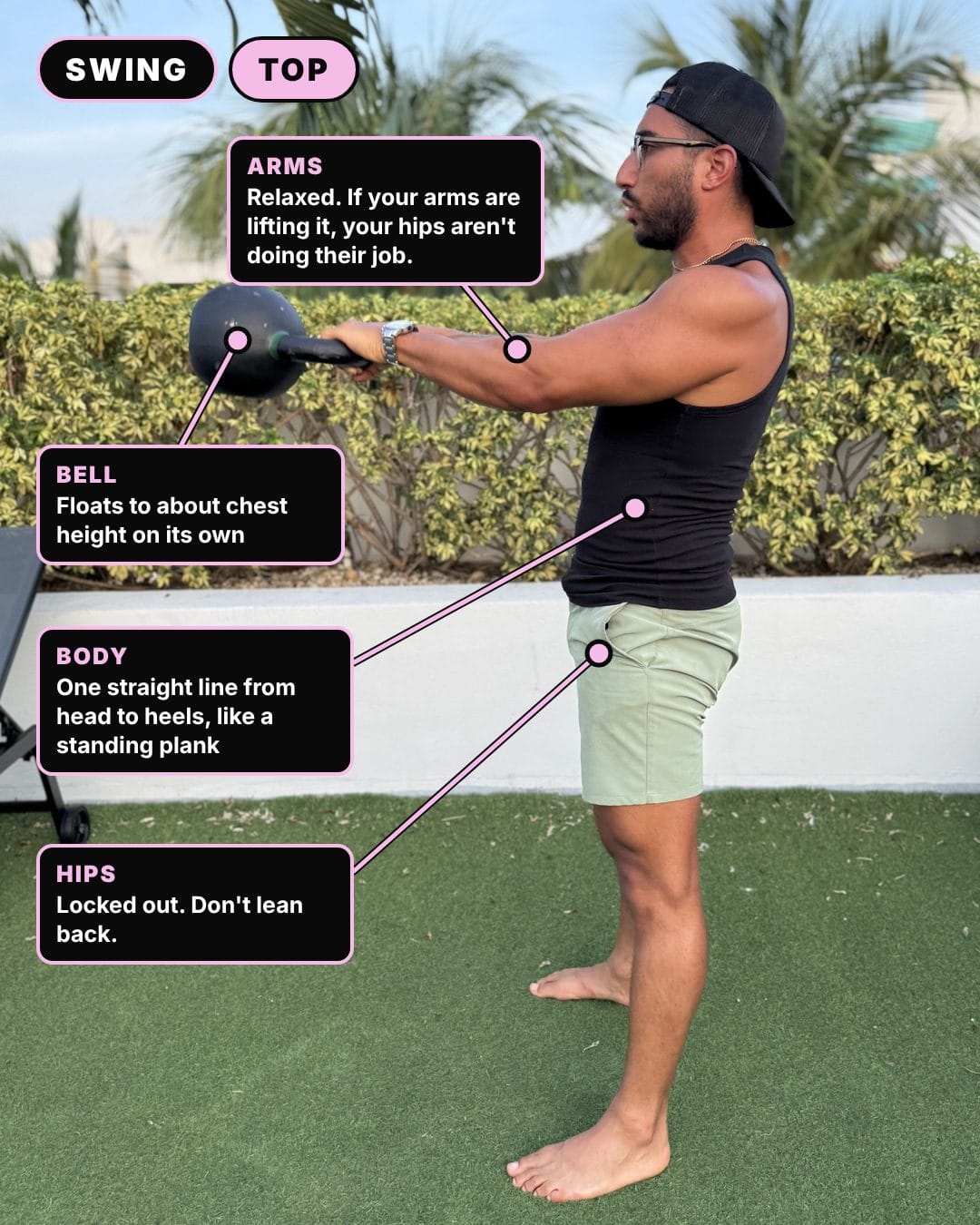
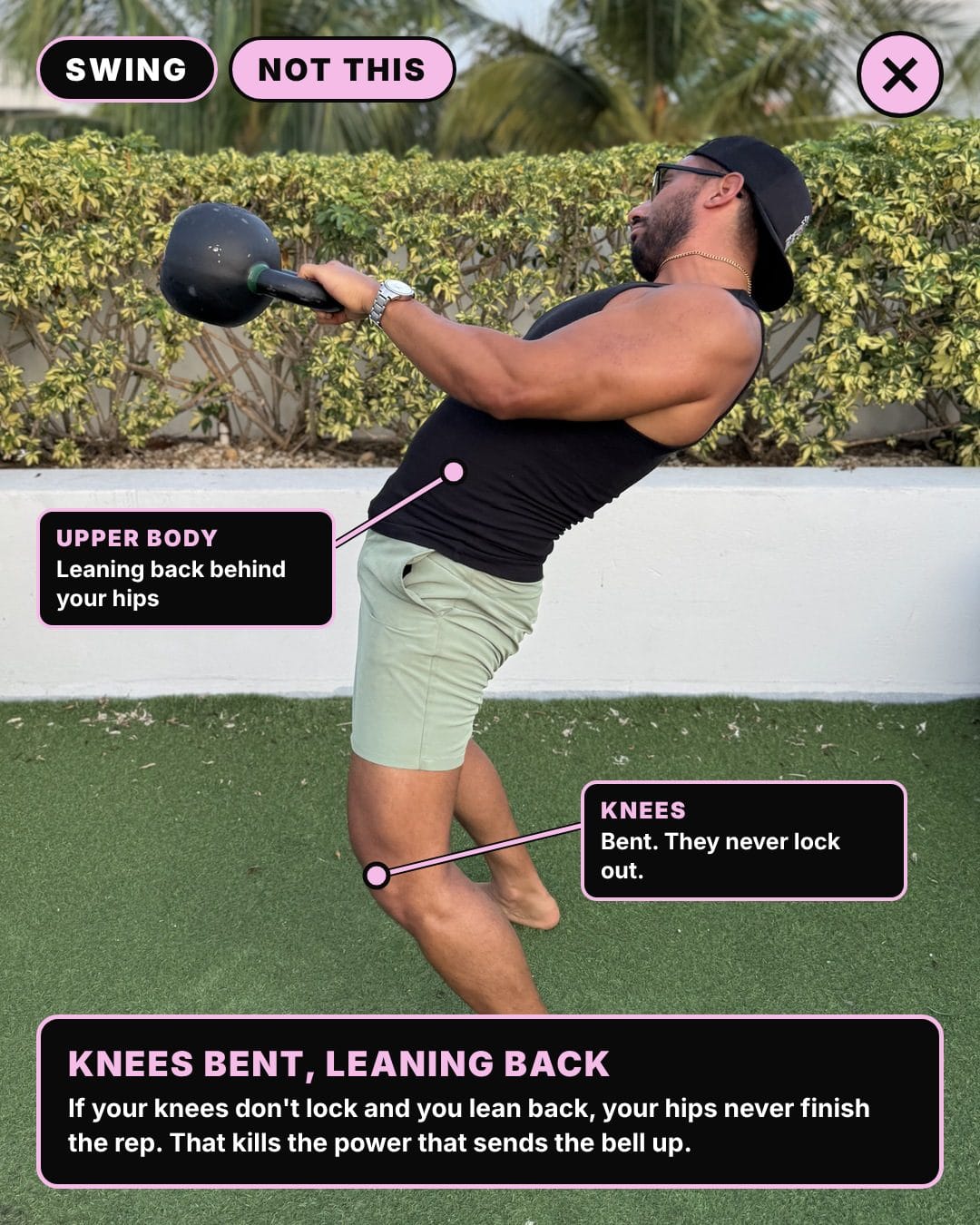
The hips do the work, the arms just guide the bell. Bell goes back behind your knees, not out in front of them. Soft knees, this isn't a squat.
MOVE 3
Single Arm Swing
Same pattern, more demand. Now your core has to work to keep you square instead of twisting.
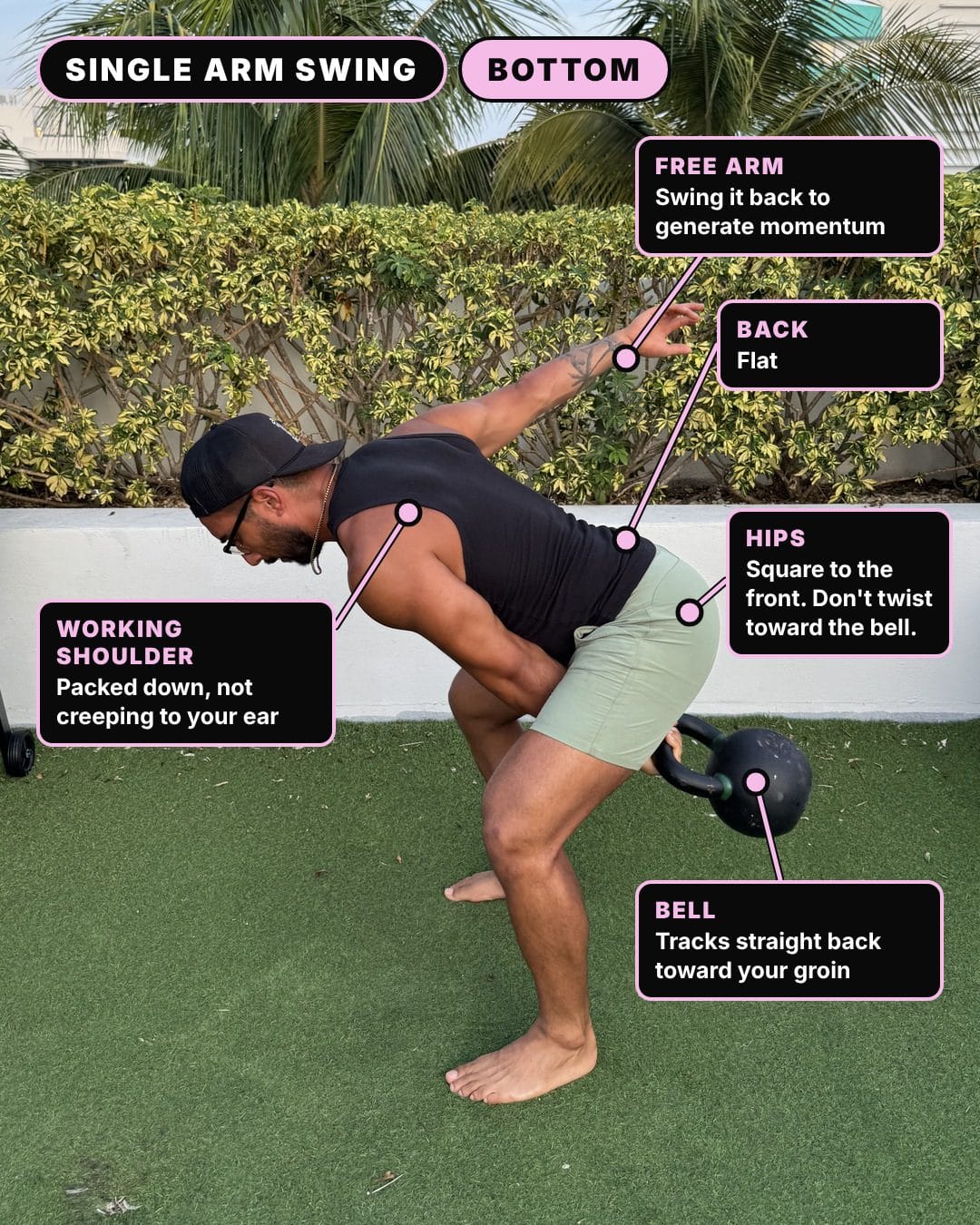
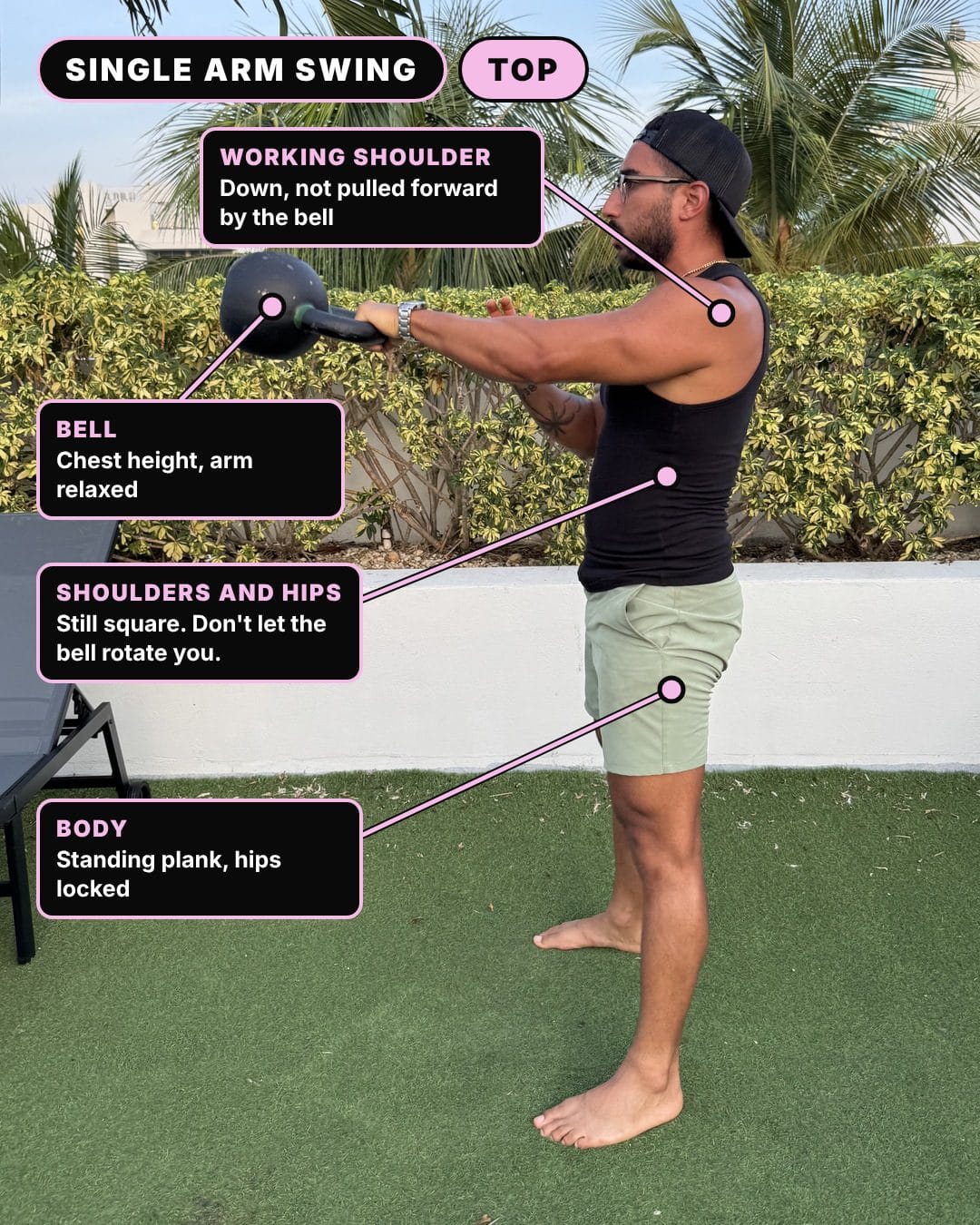
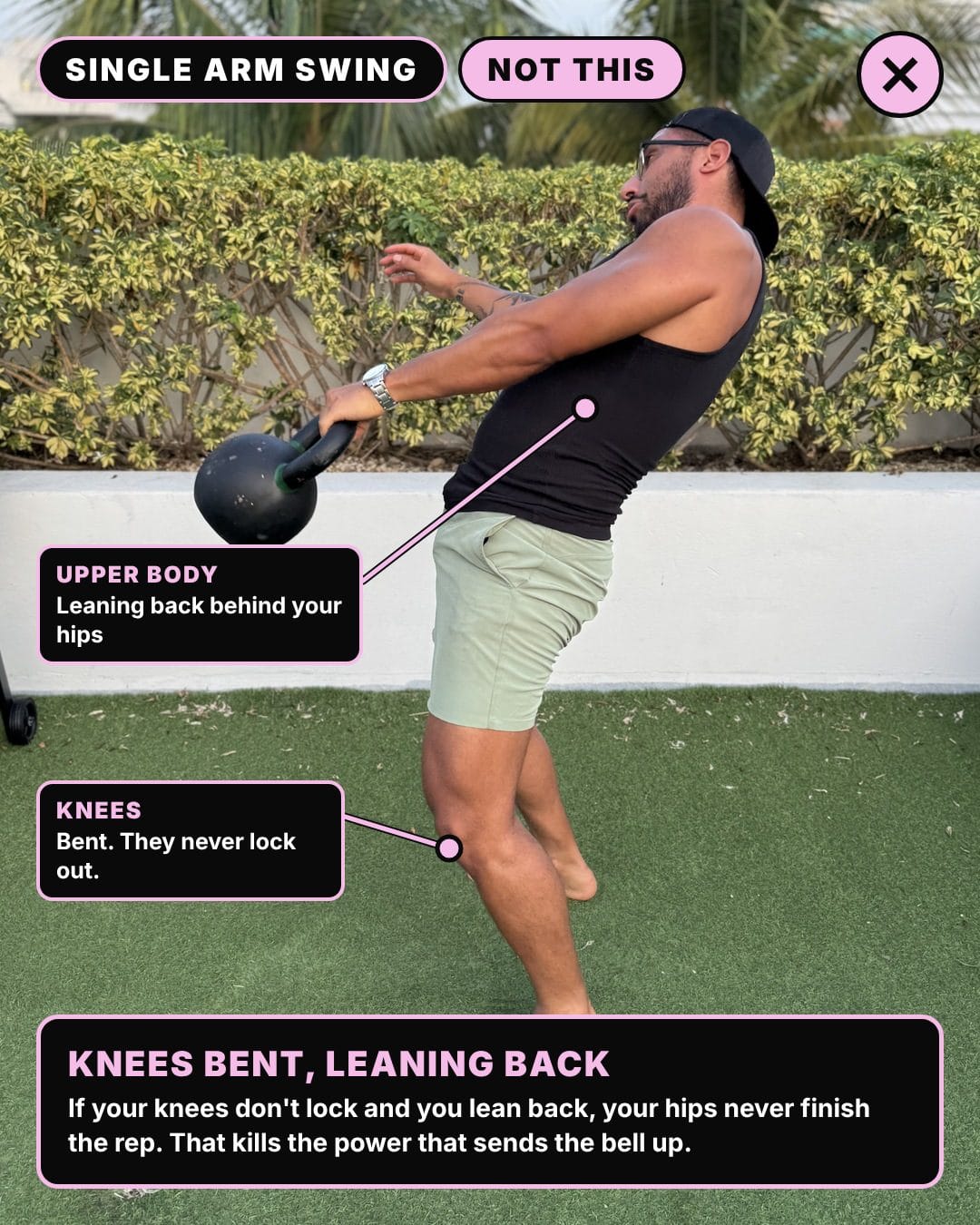
Hips stay square to the front. Working shoulder stays packed down, not creeping up to your ear. Free arm relaxed at your side.
MOVE 4
Single Arm Clean
Teaches you to make power from your hips and catch a load safely. That carries over to everything from lifting a suitcase to picking up a kid.
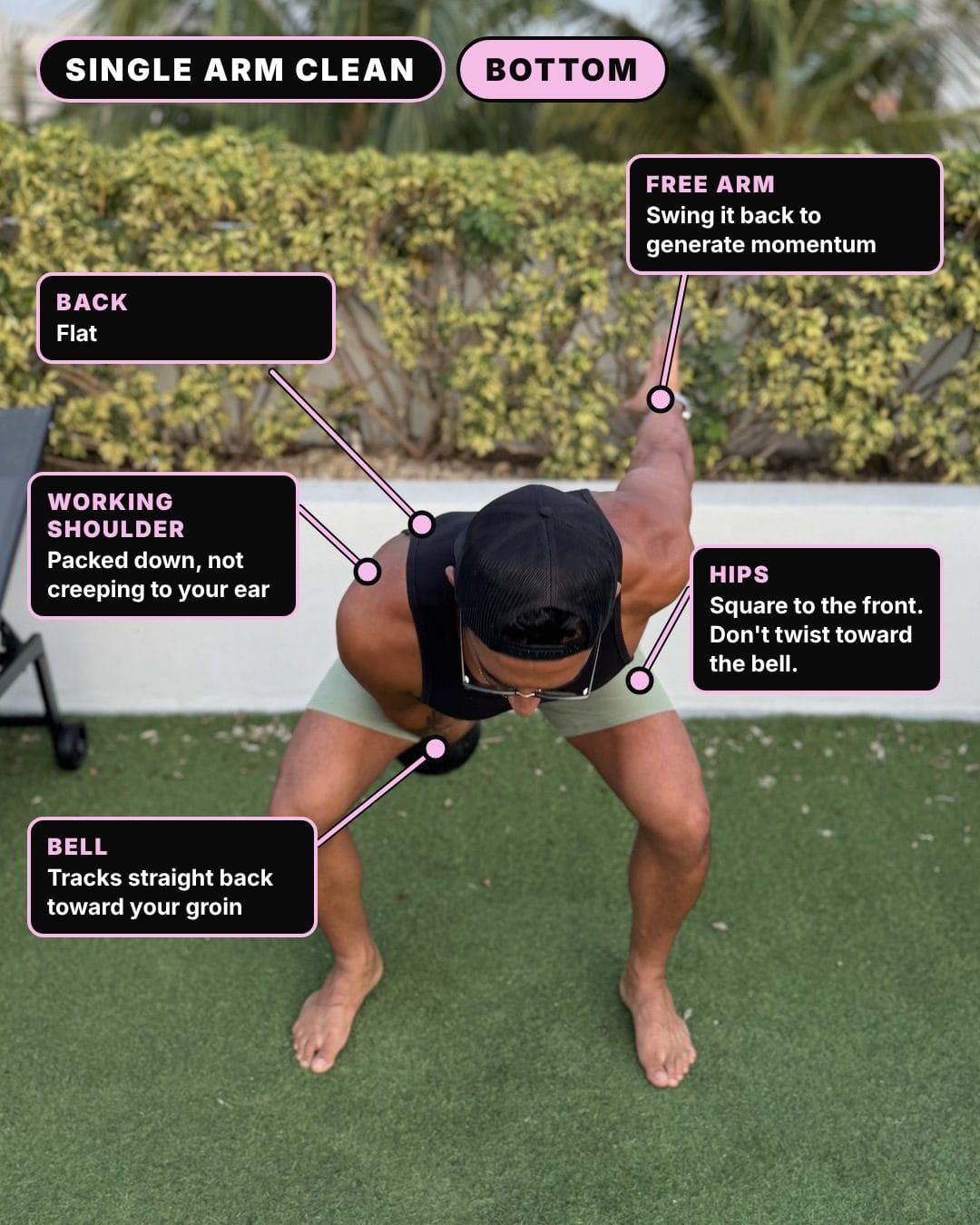
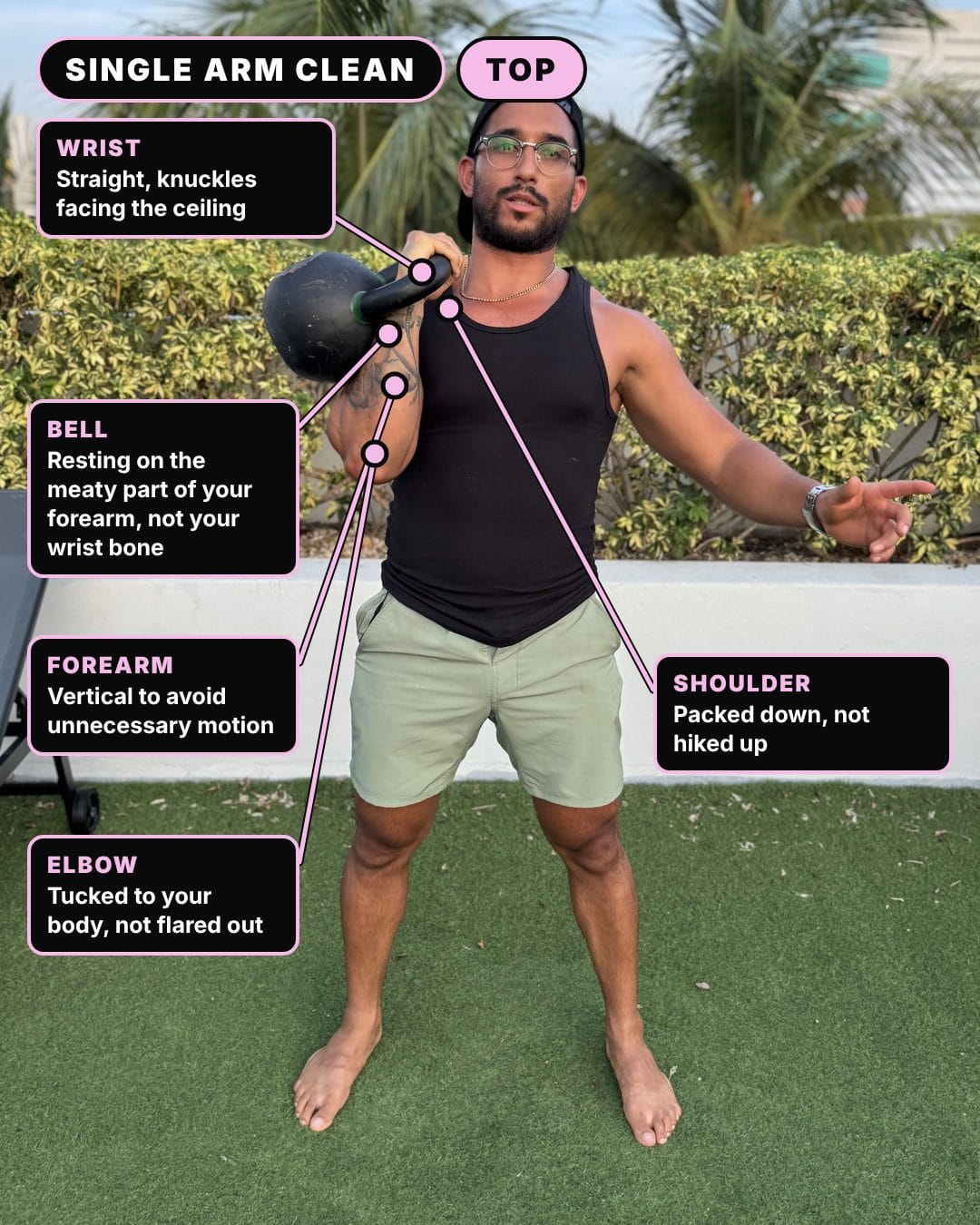
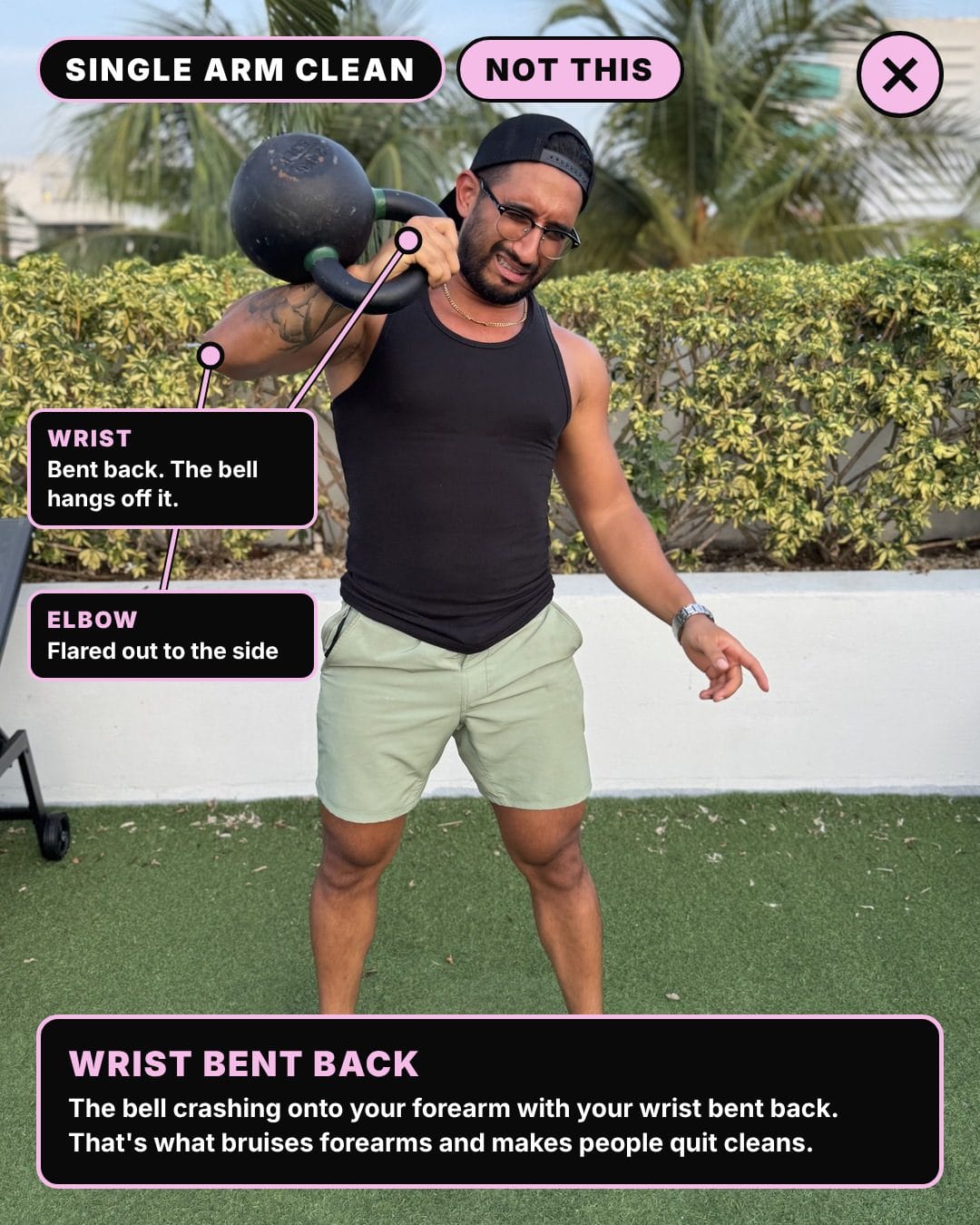
Let your hips do the lifting. If the bell bangs your wrist on the way up, the power came from your arm. Fix that first. Elbow tucked, wrist straight, bell resting on your forearm.
MOVE 5
Single Arm Press
Real overhead strength, built without wrecking your lower back to get there.
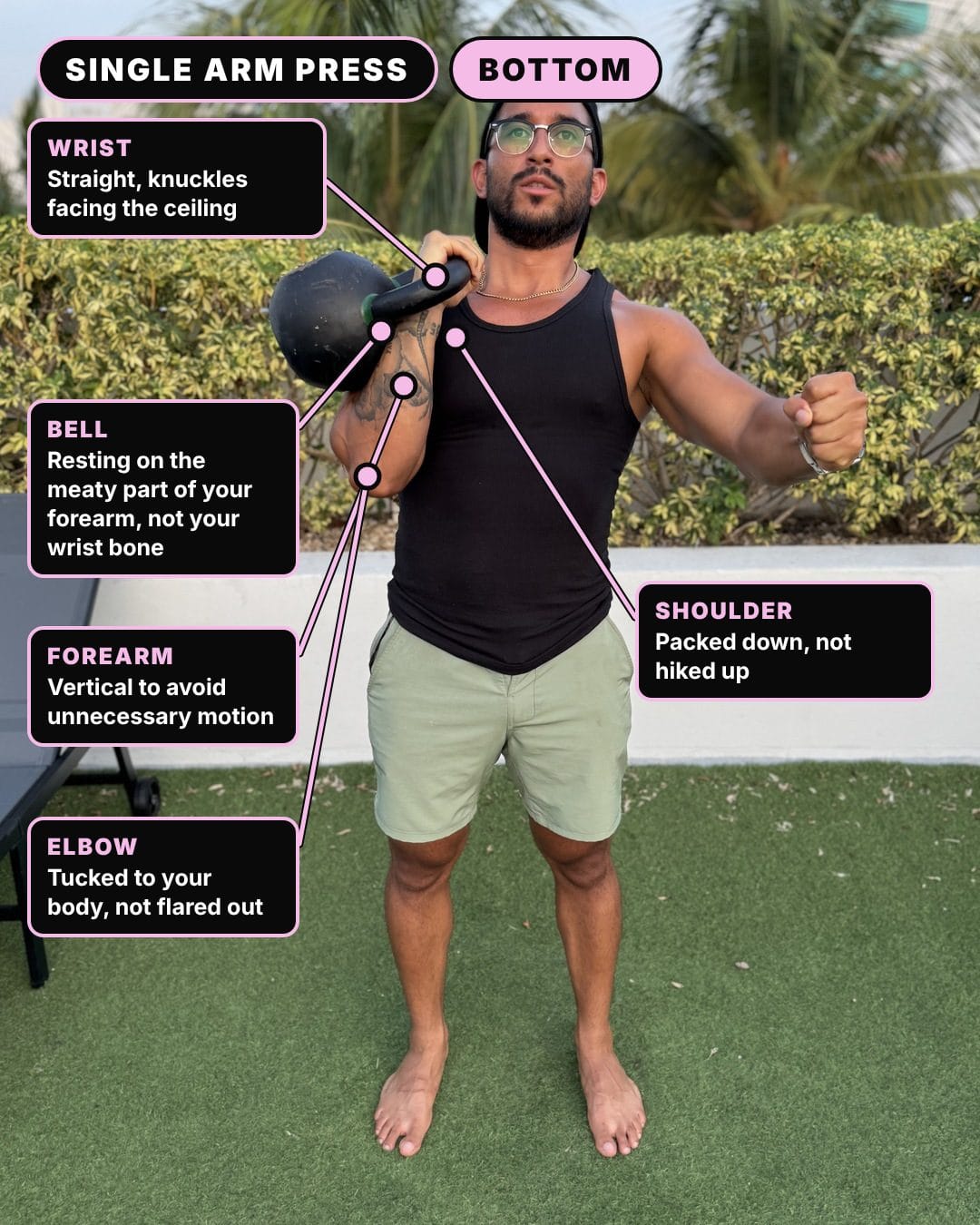
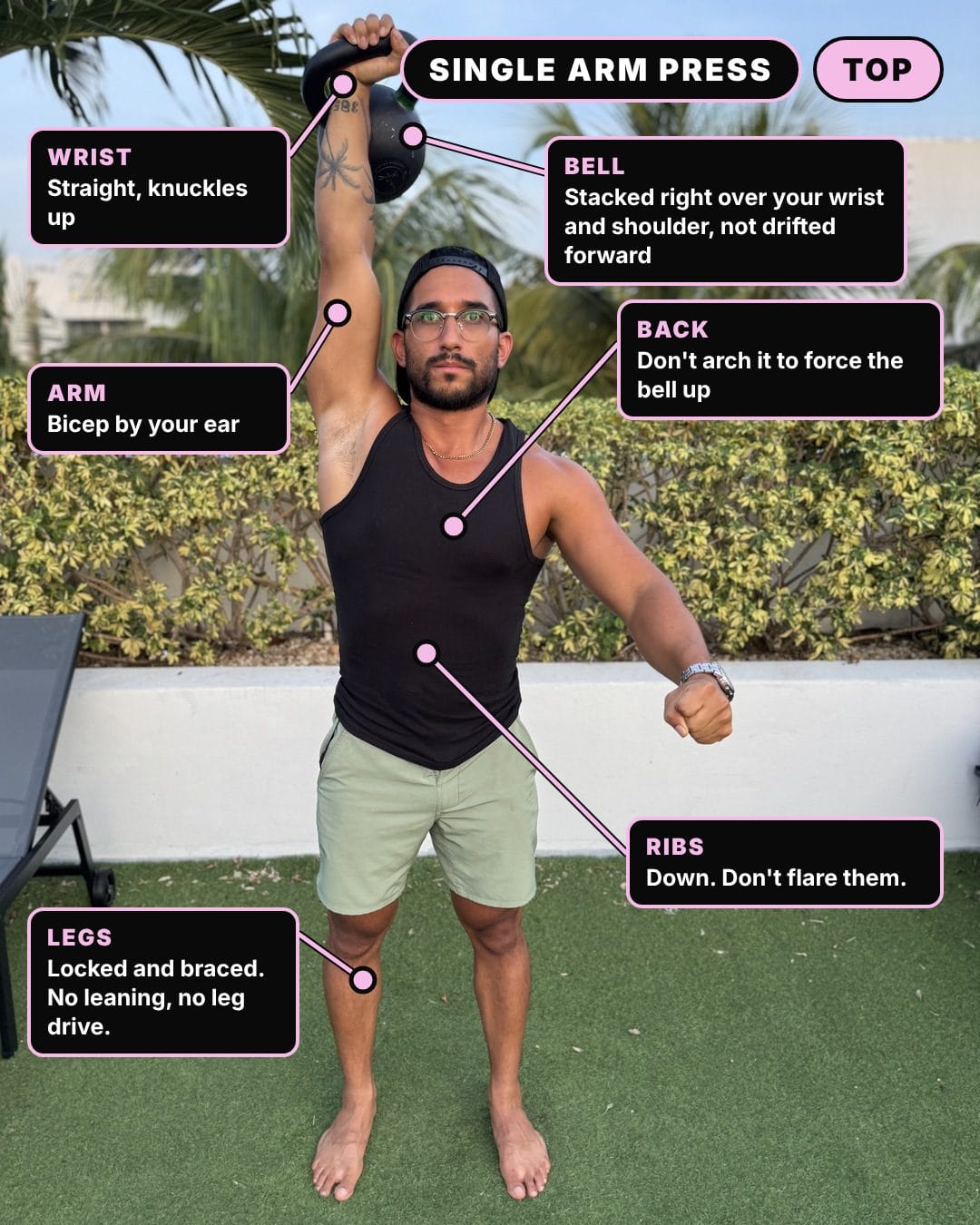
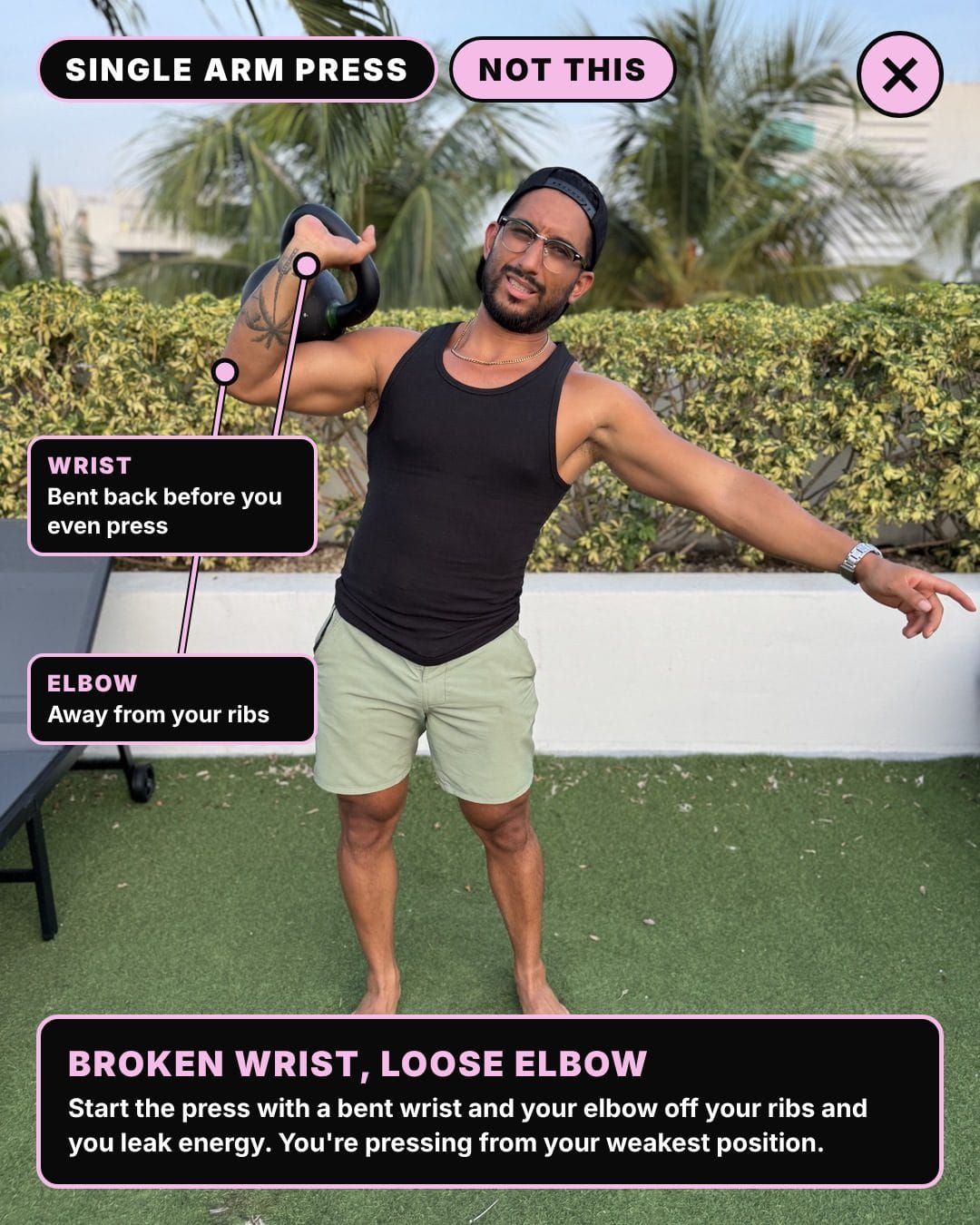
Brace like you're about to take a punch to the stomach, then press. Ribs down, legs locked. If your back arches, the bell is too heavy. Drop down a size.
06 · The warm up
Do not skip this
Same warm up before every session. About 5 minutes. It gets your joints ready for the work and it's the cheapest injury insurance you'll ever buy.
Round 1 · once through
Round 2 · 2 rounds
07 · Your 4 week program
Three days a week. About 30 minutes.
This program trains all six movement patterns your body needs every week: hinge, squat, push, pull, lunge and carry. That's how you move in real life, and it's how you build a body that's strong everywhere, not just in the mirror.
Train on three days that aren't back to back, for example Monday, Wednesday and Friday. Do the exercises in order and finish all the rounds of one before moving to the next.
Day 1 · Foundation
Day 2 · Power
Day 3 · Strength
08 · How to progress
Do a little more every week
Your body only changes when you ask it to do more than last time. Here's how to run the 4 weeks:
| Week | What to do |
|---|---|
| 1 | 3 rounds. Learn the movements. Film yourself and check your form against the photos. |
| 2 | 3 rounds. Same weight, cleaner reps, a little less rest. |
| 3 | 4 rounds of everything. |
| 4 | 4 rounds. If every rep looks good, move up a bell size on the deadlift and swing. |
Write down what you lifted every session, in a notebook or on your phone. If you don't track it, you're guessing.
How you know it's working
- The same bell feels lighter than it did in week one
- Your reps look cleaner on video
- Stairs, groceries and getting off the floor get easier
- You sleep better and have more energy in the afternoon
- Your clothes fit different, even before the scale moves
09 · Nutrition basics
You can't out train your fork
The workouts build the strength. Your nutrition decides whether you lose the fat. You don't need a strict meal plan and you don't have to give up the foods you like. You need to get two things right.
1. Control your calories
To lose fat you have to eat a little less than your body burns. Not starving yourself. Not cutting out entire food groups. Just a small, steady gap you can keep up for months, not days. Crash diets work for two weeks and then you pay it all back with interest.
2. Eat enough protein
Protein is what keeps the muscle you're building while the fat comes off. It also keeps you full, so it's easier to stay in your calories. A good target for most people is roughly 0.7 to 1 gram per pound of your goal body weight every day. Get some at every meal: chicken, beef, fish, eggs, Greek yogurt, cottage cheese or a protein shake.
Get your exact numbers
Don't guess. Plug in your height, weight, age and goal, and get your daily calories and macros in about 60 seconds.
Use the free macro calculatorGo deeper
10 · The rules
No excuses. Full ownership.
The workouts are the easy part. These are the rules that make them work.
1. Full ownership or nothing
Everything in your life right now, your health, your money, where you're at, is on you. No excuses, no blaming circumstances. The second you own that, everything gets easier, because you stop waiting for permission to change.
2. Habits over feelings
Feelings change by the hour. Habits don't ask permission. You won't feel like training most days. Do it anyway. That's the whole philosophy.
3. Keep your word to yourself first
Nothing kills trust faster than saying you'll do something and not doing it. If you can't trust yourself to show up for thirty minutes, that's the real problem, and it's bigger than your workout plan.
4. Being out of shape is a choice
Same as being in shape. It's not a life sentence and it's not a mystery. It's a pattern of choices, and you can start changing it with the next one.
5. Done beats perfect
Twenty minutes done beats an hour planned. Life gets busy. When you can't do the best thing, do the next best thing. Consistency built everything else you're proud of. It'll build your body the same way.
Pay the price now, or pay double later.
11 · Your next step
Why most people fall off
People don't fall off because they don't know what to do. After this guide, you know exactly what to do. They fall off because nobody's holding them to it. No real person checking in, making sure the work gets done, and calling them out when it doesn't.
Think about your work. You have deadlines, clients and people counting on you. If you don't deliver, somebody notices. That's why you show up. With your health, nobody's waiting on you. Skip a workout, nobody asks. Blow your nutrition all weekend, nobody knows. Fall off for three weeks, and you tell yourself you'll start again Monday.
It's not a discipline problem. You're disciplined everywhere someone holds you to it. Your health just never had that. That's the gap a coach fills.
If you're ready to take this seriously and work one on one with me, see how my clients lose the weight, get strong and keep it off, training from home.

WladFounder, The Kettlebell Academy. 11 years coaching.